An Immortal 7 March in Bangladesh’s History: Bangabandhu’s Call for Independence

Voice of People Desk, 7 March:
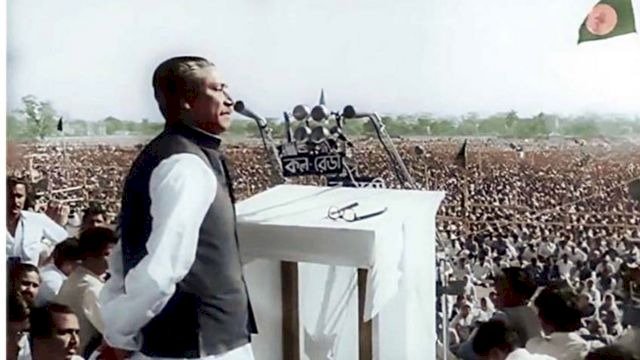
Today, 7 March, marks an immortal day in the history of Bangladesh. On this day in 1971, Sheikh Mujibur Rahman, the Father of the Nation, delivered a historic speech at the then Racecourse Ground in Dhaka (now Suhrawardy Udyan) before a crowd of hundreds of thousands. This speech inspired the Bengali nation to pursue the ultimate goal of the liberation struggle and paved the way for the Bangladesh War of Independence.

Since the creation of Pakistan in 1947 on religious grounds, Bengalis had, over 23 years, developed a strong sense of nationalism through movements such as the Language Movement, the United Front elections, and the Six-Point Programme. Despite the Awami League’s landslide victory in the 1970 election, the transfer of power to East Pakistan was denied, heightening tensions. Against this backdrop, Sheikh Mujibur Rahman made it clear in his speech: “This time the struggle is our liberation struggle; this time the struggle is the struggle for our independence.”
On that day, Dhaka was a sea of people. Millions had come from across the country to hear the voice of the leader. The capital swelled with loud slogans and processions. In his speech, Sheikh Mujibur Rahman highlighted the long-standing deprivation, oppression, and injustice faced by the Bengali people and called for unity among the citizens.
Key Messages of the Speech
In his address, Sheikh Mujibur Rahman emphasized:
-
Continuing a non-violent movement: Avoid all forms of violence.
-
Turning every home and locality into a fortress: Prepare to resist the enemy.
-
Organized resistance: Urge people to unite against exploitation and injustice.
-
Ultimate goal of independence: “This time the struggle is our liberation struggle; this time the struggle is the struggle for our independence.”
He stressed the importance of peace and civil disobedience to inspire future generations. Sheikh Mujibur Rahman also highlighted that this struggle was essential for securing civil rights and national dignity for the people.
Broadcast and Protest
The Pakistani military authorities initially did not allow the speech to be broadcast live on Dhaka Radio. In protest, Bengali employees went on strike, causing the station to be inoperative from the afternoon. Finally, late at night, permission was granted to broadcast the full speech. People eagerly waited in front of their radios to listen.
Global Recognition
The 7 March speech is considered one of the timeless speeches in world history. On 30 October 2017, UNESCO inscribed it in the International Register of the ‘Memory of the World,’ recognizing it as a part of global heritage—Bangladesh’s first such recognition.
An International Advisory Committee (IAC) convened for four days from 24 to 27 October at UNESCO headquarters in Paris. The committee, chaired by Abdullah Alraisi, Director General of the National Archives of the United Arab Emirates, evaluated 78 nominated documents proposed by various countries for inclusion in the Memory of the World International Register. After a two-year process, the nominations were finalized for 2016–17.
The Memory of the World program was launched by UNESCO in 1992 to promote awareness of the preservation and use of documentary heritage worldwide.
Even today, 7 March is remembered as a symbol of the Bengali nation’s spirit of independence—a speech that united the people and charted the path to realizing the dream of freedom.