
"Shahed Drone Strikes by Iran Are Changing the Face of Warfare in the Middle East"

World News Desk, London, 14:11: Iran’s controversial Shahed-136 attack drones, once widely known for terrorising the skies over Ukraine, are now appearing across the Middle East. Over the past 48 hours, hundreds of these drones have reportedly been launched toward several Gulf countries, raising fresh concerns about Iran’s growing drone warfare capabilities.
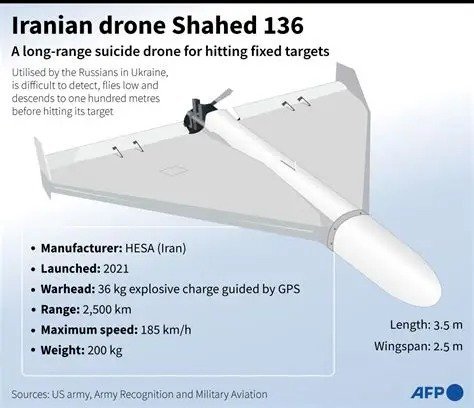
The Iranian-made drones are relatively large, noisy, and designed with a distinctive delta-wing shape. Each unit costs roughly $50,000 and is far cheaper and easier to manufacture than ballistic missiles. Because of this low cost and rapid production capability, analysts believe Iran can sustain the use of these drones in conflicts for a long time.
Recent attacks have been reported in Bahrain, Kuwait and the United Arab Emirates, where drones struck buildings and strategic facilities. In one widely circulated video from Bahrain, a drone can be seen flying toward a residential tower at night. The engine produces a sound similar to a lawnmower before the drone crashes into the building, sending flames and debris into the air.
The wave of attacks comes after the United States and Israel launched strikes against Iran earlier in the week. Since then, more than 1,000 drones are believed to have been directed toward Gulf-region targets.
Authorities in the United Arab Emirates said on Monday that 689 drones had been launched toward the country. Air defence systems managed to intercept 645 of them, meaning around 44 drones – just over six per cent – managed to slip through defences.
Technically, the Shahed-136 is about 3.5 metres long with a 2.5-metre wingspan. Although relatively slow, the drone can carry an explosive payload of roughly 50 kilograms. This amount is capable of causing serious damage to buildings or infrastructure, though it may not destroy large structures.
However, the psychological effect of these drones is significant. Their loud engine noise and sudden terminal dive toward targets often create fear among civilians before the explosion occurs.
Another video from Bahrain appears to show a drone flying above a naval base hosting the US Fifth Fleet, before diving down and destroying a radar dome.
Reports of similar strikes have emerged from Kuwait and the UAE, and there are also indications that a British RAF facility at Akrotiri in Cyprus may have been targeted.
One of the most concerning features of the Shahed-136 is its long operational range. The drone can reportedly travel up to 2,000 kilometres, usually following a pre-programmed route that keeps it flying low to the ground to avoid radar detection. Evidence from the war in Ukraine also suggests that some drones can be remotely controlled, allowing operators to alter their path at the last moment.
The Shahed-136 was developed in Iran toward the end of the last decade. It first gained global attention in July 2021, when a drone attack on an Israeli-linked oil tanker killed a British and a Romanian crew member.
The drone later became widely known after Russia began using it extensively in the Ukraine war in 2022, often launching large swarms of drones alongside cruise and ballistic missiles to overwhelm Ukrainian air defences.
Military analysts warn that if Iran adopts similar tactics in the Gulf region, critical infrastructure could face increasing threats. In one recent incident, a drone attack triggered a fire at Saudi Arabia’s Ras Tanura oil refinery, one of the largest in the world, forcing the facility to temporarily shut down.
With its low cost, long range and growing production capacity, the Shahed drone is now emerging as a key weapon in Iran’s military strategy. The developments raise a broader question for the region: how far is Iran prepared to push its drone warfare capability, and how long it can sustain such a strategy in a wider conflict.