“From Land to Land, From Shore to Shore — Voice of People at Every Door.’’
90 Years After Cable Street: What East London Remembers—and What Britain Should Learn

Voice of People Feature | London, 4 October :
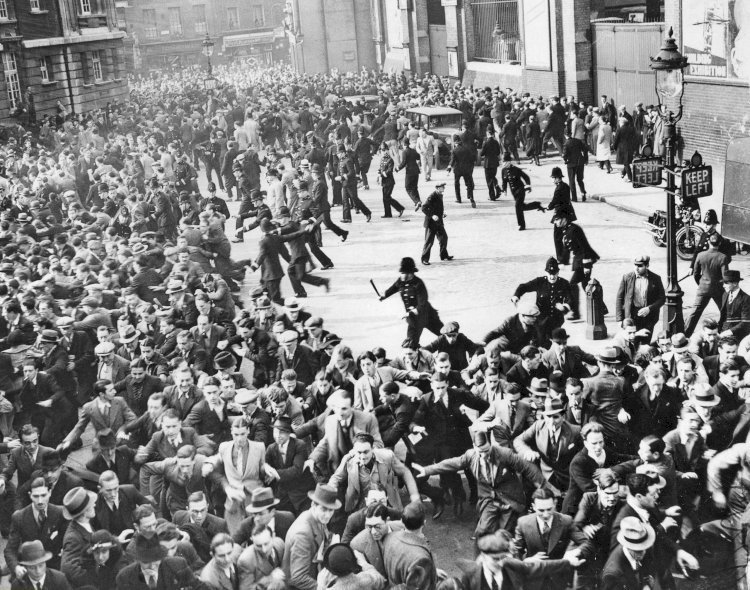
Ninety years ago today, a street in East London became the stage for one of the most remembered confrontations in modern British history.
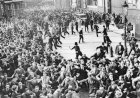
On 4 October 1936, thousands of people gathered in and around Cable Street, Whitechapel, to prevent a planned march by Sir Oswald Mosley’s British Union of Fascists through an area with a large Jewish population. The confrontation brought together Jewish residents, dockers, trade unionists, socialists, communists, anarchists and other local residents. The police attempted to clear a route for the fascist march, but the resistance was so strong that the planned route could not be maintained.
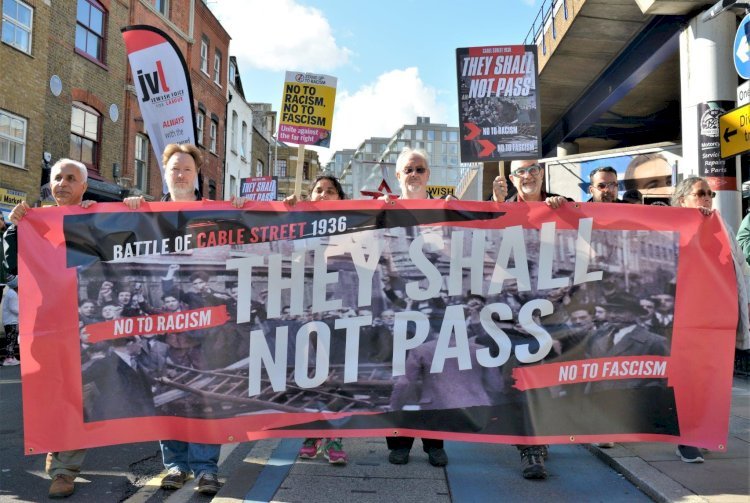
Today, 90 years later, East London remembered that day again.
Thousands marched from Tower Hamlets Town Hall towards St George’s Gardens on Cable Street. Banners carried messages against antisemitism, Islamophobia and racism, while the familiar words “They shall not pass” once again appeared on the streets.
But Cable Street is more than an anniversary.
It is a question about Britain.
What happens when fear, economic anxiety and political division are turned against a particular community? And what happens when ordinary people decide that intimidation will not determine who belongs in their neighbourhood?
A street, a community and a confrontation
The Britain of 1936 was very different from the Britain of today. The country was still dealing with the effects of the Great Depression, unemployment and deep political divisions. Mosley’s movement had developed a significant profile, while antisemitic attacks and violence against political opponents were occurring in East London.
The proposed march through the East End’s Jewish neighbourhood was therefore seen by many local people as a deliberate provocation.
The National Archives records that the British Union of Fascists supported fascism and that its planned march was intended to pass through areas with significant Jewish populations. A broad coalition of working people, Jewish residents, dockers and immigrants mobilised against it.
The popular memory of Cable Street often presents the event simply as local people defeating fascists.
The historical record is more complicated.
National Archives documents show that the principal confrontation was not simply between fascists and anti-fascist demonstrators. Much of the direct conflict was between counter-demonstrators and police officers attempting to maintain order. Among those arrested were women and children, while the overwhelming majority of arrests were not of fascists.
Eventually, Metropolitan Police Commissioner Sir Philip Game concluded that allowing Mosley’s planned march and meetings would result in serious disorder. Mosley abandoned the proposed route and turned towards the Embankment instead.
That detail matters.
History is rarely as neat as its slogans.
But the historical complexity does not make Cable Street less important. If anything, it makes the story more revealing.
From Jewish East End to multicultural East London
The East End has changed enormously since 1936.
The Jewish community that once formed such a large part of Whitechapel and surrounding areas declined over subsequent decades. New generations of migrants arrived. Among them were people from South Asia, particularly Bangladesh.
Today, Tower Hamlets is one of Britain's most diverse boroughs.
The restaurants, shops, mosques, schools and businesses of today's East London tell another chapter in the area's long history of migration.
That makes Cable Street particularly relevant to Britain's Bangladeshi community.
The street that witnessed Jewish and Irish working-class communities confronting fascism is now part of an East London shaped by generations of migration from Bangladesh and elsewhere.
The people have changed.
The arguments about belonging, prejudice and community have not disappeared.
Why the mural still matters
On the wall of the former St George's Town Hall stands the enormous Cable Street mural, depicting the confrontation of 1936.
Painted between 1976 and 1983, the mural has become one of East London's most recognisable public artworks. It turns a complicated historical event into a visual memory of resistance and community mobilisation.
For someone walking along Cable Street today, the mural offers an extraordinary encounter between past and present.
Modern London moves around it—buses, shops, restaurants, cyclists, commuters and residents going about their daily lives.
Yet the painted figures on the wall seem to ask a question that remains contemporary:
Who gets to feel safe in a neighbourhood?
And perhaps an even bigger question:
How should a diverse society respond when one community is made the target of hatred?
The meaning of Cable Street in 2026
Sunday's 90th-anniversary march was not simply a history lesson.
Many participants explicitly connected the memory of 1936 with contemporary arguments over racism, Islamophobia, antisemitism and the far right.
That contemporary connection also makes the anniversary politically sensitive.
There were disagreements among participants over issues including Israel and Palestine, and a brief confrontation occurred between marchers and two counter-protesters associated with the Campaign Against Antisemitism.
That is another reason Cable Street deserves to be remembered carefully.
Its lesson cannot simply be reduced to “our side was right and their side was wrong.”
The deeper lesson is about what happens when communities become divided into permanent enemies.
A society can remember the past without turning history into another weapon in the present.
What Britain should learn
Perhaps the most important lesson of Cable Street is not that one particular political movement was stopped on one particular afternoon.
It is that democracy depends on what ordinary citizens do when democratic values come under pressure.
Jewish residents were not alone.
Dockers were not alone.
Trade unionists were not alone.
Immigrants were not alone.
Different groups with different political beliefs came together around a basic principle: a community should not be intimidated simply because it is vulnerable or unpopular.
That principle remains relevant in modern Britain.
But there is another lesson.
The National Archives warns against treating Cable Street as a simple heroic legend. Its records show that support for the British Union of Fascists actually increased in East London immediately after the confrontation.
So winning one street does not necessarily end intolerance.
Stopping one march does not eliminate prejudice.
And remembering one historic victory does not guarantee that future generations will make the same choices.
That is perhaps the most uncomfortable—and most valuable—lesson of all.
Ninety years later
This afternoon, people once again walked through Whitechapel carrying banners and remembering a day when East London became a national symbol.
The faces are different.
The languages spoken on the streets are different.
The restaurants and shops are different.
The political arguments are different.
But the fundamental challenge remains familiar.
Britain is still a country of different communities living alongside one another. Its strength depends not on everyone becoming the same, but on different communities being able to live with dignity, security and equal rights.
Cable Street therefore belongs not only to the Jewish history of East London, nor only to the history of British anti-fascism.
It belongs to the wider history of modern multicultural Britain.
For today's Bangladeshi Londoner walking past the mural, there is an especially powerful connection.
The community that now calls East London home inherited streets shaped by earlier generations of migrants who themselves arrived looking for work, security and a future.
History reminds us that today's established community can once have been yesterday's newcomer.
And tomorrow's newcomer may one day become an essential part of Britain's story.
Ninety years after Cable Street, perhaps that is what East London remembers best:
A neighbourhood is never truly defined by who arrived first. It is defined by how its people choose to live together.