STORYTELLERS RULE THE WORLD
Nirjhor’s Crisp Micro Stories ।। 46 ।। My Father Is a Good Man

DEDICATION
To all the Bakuls of the world—
those who, forgetting every judgment in the world,
still say, “My father is a good man.”
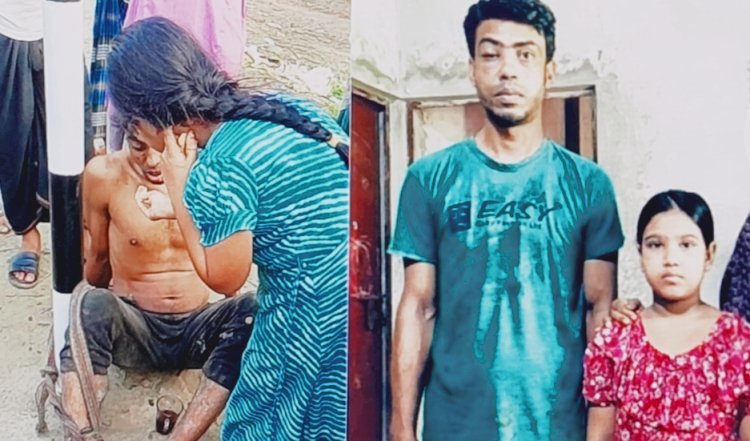
A small market in Uzirpur, Barishal. The morning has not yet fully come alive, but the tea stalls are already filling up with people. Some stand with cups of tea in their hands, while others move from one shop to another carrying market bags. Fish sellers arrange their fish, vegetable vendors call out to customers, and rickshaws and vans slowly make their way through the narrow market roads. The familiar bustle, conversations and curiosity of village people gradually bring the market to life.
Suddenly, an unusual crowd gathers at one side of the market. Curious people push against one another, trying to get closer. Some peer from a distance, while others take out their mobile phones to take pictures. There is anger on some faces, curiosity in some eyes, and compassion on others.
In the middle of the crowd, a man sits with his hands and feet tied to a post. The exhaustion of spending the entire night in such a position is clearly visible on his face.
Someone in the crowd says the man was caught while trying to steal. Another says there have apparently been complaints against him before. Someone else angrily says that he should be punished properly before being handed over to the police.
But not everyone agrees.
A few people repeatedly insist that if he has committed a crime, he should simply be handed over to the police.
—If he stole something, hand him over to the police. There’s no justification for beating him like this.
—But they say he has done this before.
—A complaint against someone doesn’t give us the right to beat him.
—Give him to the police. Let the law take its course.
At that moment, a seven- or eight-year-old girl slowly makes her way through the crowd. Her name is Bakul. She is wearing an old dress, her hair is untidy, and fear is written all over her face.
Even in the middle of so many people, her eyes are searching for only one person.
Suddenly, she sees the man sitting beside the post.
She stops.
Then she runs toward him and stands directly in front of him.
—Father!
The man raises his head.
The moment he sees his daughter, the hardness on his face disappears.
—Bakul! What are you doing here, my child?
Bakul stares at her father's bound hands. Her eyes fill with tears.
—Why have they tied you up?
Her father cannot look into her eyes.
—Go home, my child.
—No. I won't leave you here.
Several people standing in the crowd look at the little girl. Some of those who had been speaking angrily only moments earlier now begin to change their expressions.
An elderly man sighs.
—Oh, what has this little girl done to deserve this? Who knows what is going through her mind seeing her father like this!
Another man says,
—Even if the father is guilty, the girl is not.
A man from the nearby tea stall brings a bun and a cup of tea and places them in Bakul's hands.
—Here, child. Feed your father.
Bakul takes the bun.
Very carefully, she breaks it into small pieces. Then she dips one piece into the tea and holds it to her father's mouth.
—Father, eat.
The man looks around. The humiliation of sitting there in front of so many people seems even heavier now. But his daughter's hand is still held out toward his mouth. Slowly, he takes the piece of bread.
Bakul dips another piece into the tea and holds it out again.
—Have another one.
Her father looks at her and says softly,
—You haven't eaten?
—No.
—Why?
—You eat first.
Tears begin to roll down the man's cheeks. Bakul looks at her father in surprise.
—Father, why are you crying?
—It's nothing, my child.
—Does it hurt?
—No.
Bakul places her little hand on her father's cheek.
At the touch of her tiny hand, the man closes his eyes.
A woman standing in the crowd wipes her eyes with the edge of her sari.
—Look how much the girl loves her father. You wouldn't believe what people have come to unless you saw it with your own eyes.
Another man says quietly,
—That's the bond between a father and a child. Even when a father makes a mistake, a child still sees him simply as Dad.
Bakul dips another piece of bread into the tea and feeds her father. Then, suddenly, she says,
—Father, you are a good father.
The man looks at her in surprise.
—Who told you I'm a good father?
Bakul looks at him with innocent eyes.
—No one.
—Then how do you know?
Bakul thinks for a moment.
Then she slowly says,
—You cover me with a blanket and put me to sleep at night.
The man's eyes fill with tears again.
Bakul continues,
—When I'm sick, you put water on my head. When I go to school, you stand at the corner of the road. When my shoes tear, you buy me new ones.
The father can no longer look at his daughter. He lowers his head and sits quietly.
Bakul wipes the tears from his eyes with her little hand.
—Don't cry, Father.
—Why?
—People are watching.
Several people in the crowd now turn their faces away.
Many of those who had been speaking harshly against the man only moments ago now have nothing more to say.
A young man speaks softly,
—If the allegations are true, hand him over to the police. But don't beat him in front of his daughter anymore. It could leave a scar on her heart for the rest of her life.
Another man immediately says,
—Exactly. We shouldn't take the law into our own hands.
The tension in the market gradually begins to fade.
People's eyes are now fixed more on little Bakul than on the man.
She is still feeding her father pieces of bread, as if there is no one else in the world, no accusation, no judgment—only her father.
Later, officials arrive. They speak with local people about the incident. Steps are taken to help rehabilitate the father. An initiative is also announced to support Bakul's education and to help arrange work for her mother.
Bakul understands none of this.
She simply stays beside her father.
Eventually, the ropes around her father's hands are removed.
The man slowly stands up. His legs tremble after sitting in the same position for so long.
Bakul immediately takes his hand.
—Come on, Father.
The man places his hand gently on his daughter's head.
—Let's go, my child.
The two of them slowly begin walking through the crowd.
Several people watch them leave.
No one says anything.
Only the man from the tea stall watches from a distance—the man whose cup of tea and bun had helped little Bakul feed her father that day.
The market gradually returns to normal.
The calls of the fish sellers, the cries of the vegetable vendors and the bells of the rickshaws can once again be heard as before.
But those who witnessed what happened carry with them the image of little Bakul and her simple faith.
Bakul has no document containing the accusations against her father. She has no witnesses, no courtroom, and no judgment.
What she has are a few small memories—her father covering her with a blanket at night, putting water on her head when she was sick, standing by the road when she went to school, and buying her a new pair of shoes when her old ones tore.
In the adult world, there may be many questions about a person. But in a child's world, sometimes the answer is very simple.
Holding her father's hand tightly as they walk, Bakul says once again,
—Father, you are good.
This time, the man says nothing.
He simply holds his daughter's hand even tighter.
And inside little Bakul's tiny hand, it seems as though her father's entire world is being held.
London, October 1, 2026