
For the English Readers
The Echo of the Times || 136 || Hazrat Shahjalal (R.) or Shrine Worship of Saints, Vows, Supplication to the Dead and the Position of Islam


Dedication
“To those who wish to understand religion freed from blind belief”
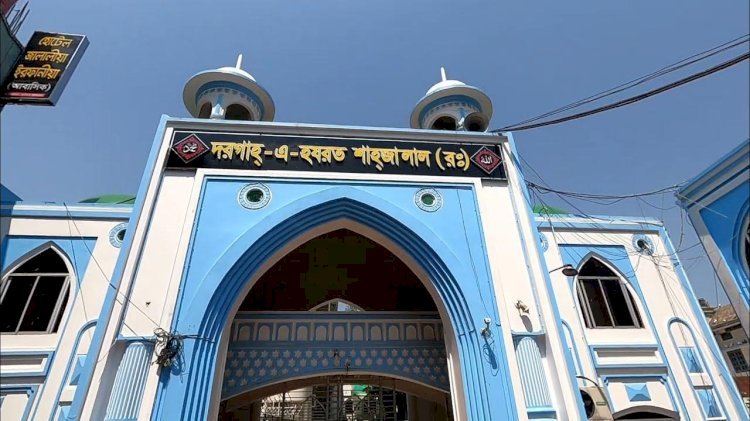
Saint Hazrat Shahjalal (R.) Dorga Complex
I have been writing since the 1990s. The reason has always been self-awareness and making others aware of the same. But nowadays, both at home and abroad, the declining moral and ethical state of our Bengali community sometimes makes me feel—out of anger and sorrow—that I should stop writing altogether. It feels as if people have not changed at all.
Over the past few days, what I have seen and read in newspapers regarding vows, money offerings, and donations at the shrine of Hazrat Shahjalal (R.) gives the impression that people are, in fact, sliding further downward. At times, the question arises in my mind—what is the point of writing at all? But out of habit, I still end up sitting at my writing desk again.
Having grown up around the shrine of Hazrat Shahjalal (R.) and later living for a long time in London, I feel that the standards of the shrine environment and so-called Muslim practice have now fallen even lower than before. Recent reports suggest that in just three days, around 1.75 million in cash—along with pounds, dollars, and even gold ornaments—have been collected in the large donation cauldron of Shahjalal’s shrine, offered as vows and charity.
From childhood, we have seen that a group of so-called attendants living around the shrine control this money through various means. Yet people continue to give charity from all over the country. During my time in Bangladesh, India, and later in London, I met many Bengalis. Surprisingly, even highly educated individuals go to shrines, make vows, offer money, and seek prayers at the graves of saints and mystics. I often hear educated people referring to “Shahjalal Baba.” But he was never married—so how can he be anyone’s “father”?
Every day, hundreds of people come from different districts by train and bus to the shrine with various vows. Yet in Islam, apart from three mosques, travelling specifically for visitation with religious intent to any other mosque or grave is prohibited. Those three mosques are the Kaaba in Makkah, Masjid an-Nabawi in Madinah, and Bayt al-Maqdis in Jerusalem. Many educated people are unaware of even this basic fact.
Some people return from London or America and first go directly to the 'shrine' to seek prayers or make vows, claiming they have no shortage of dollars or pounds. Many major political leaders visit the shrine before elections to seek blessings or make offerings.
What is even more astonishing is that many so-called progressive individuals are also involved in such practices. Most surprisingly, they still identify themselves as Muslims and consider this to be a righteous act. People of other religions also visit and make offerings. The question is: Does this understanding of the educated class align at all with the true teachings of Islam?
We will now examine this in the light of the Qur’an and authentic Hadith.
A common belief among many Muslims in the Indian subcontinent is: “The true servants of Allah do not die.'' Based on this, many argue that even after the death of a saint or spiritual guide, it is permissible to seek help from them, make vows at their shrines, or pray at their graves for relief from hardship. Some say, “We do not worship them; we only take them as a means (wasilah).”
But the question is: what do the Qur’an and authentic Hadith say?
The Arabic word “wasilah” (الوسيلة) means a means, a way of approach, or a medium of closeness to Allah.
The Qur’an clearly mentions “wasilah”:
“O you who believe! Fear Allah and seek the means (wasilah) to approach Him…”
(Surah Al-Ma’idah 5:35)
In Islamic interpretation (including Tafsir Ibn Kathir), wasilah refers to lawful means of gaining closeness to Allah, such as faith, righteous deeds, prayer, fasting, charity, and supplicating to Allah through His names and attributes.
Authentic Hadith also shows that the Companions of the Prophet (Sahabah) made dua directly to Allah or through the supplication of living righteous people. For example, the famous story of the three men trapped in a cave who used their good deeds as a means (wasilah) to ask Allah for help (Sahih Bukhari).
The important point here is this:
In Islam, “wasilah” never means calling upon the dead or seeking direct help from them. Rather, it refers to lawful, Sharia-compliant means of approaching Allah.
Therefore, the claim “we take them as wasilah” must be understood correctly: wasilah in the Qur’anic sense means righteous deeds and permissible means of seeking Allah’s acceptance—not turning any person into an object of worship.
Some people argue that saints are guides on the path to Allah and can intercede, or that they are spiritually alive in the grave. Let us see what Allah says.
The meaning of martyrdom and life after death
The verse often cited is:
“Do not say about those who are killed in the way of Allah that they are dead. Rather, they are alive, but you do not perceive it.”
(Surah Al-Baqarah 2:154)
And also:
“Do not think of those who are killed in the way of Allah as dead. Rather, they are alive with their Lord, receiving provision.”
(Surah Aal-e-Imran 3:169)
These verses refer specifically to the special status of martyrs. Nowhere in these verses is it stated that people on earth may call upon them, make vows to them, or seek help from them. Rather, Allah clearly states that they are receiving provision from Him.
Thus, martyrs have a special form of life in Barzakh, but it is not a worldly life. They do not eat, drink, or function like the living in this world. Therefore, building domes over graves, covering them with cloths, or organizing rituals and fairs in their name has no basis. Their need for money or offerings does not exist. This is common sense—does one really need a PhD in theology to understand it?
Can the dead hear human calls?
Allah says:
“Indeed, you cannot make the dead hear.”
(Surah An-Naml 27:80)
And also:
“You cannot make those in the graves hear.”
(Surah Fatir 35:22)
These verses clearly indicate that the dead cannot hear human calls in a way that enables them to respond or help.
Whom should we call in times of distress?
Allah says:
“Indeed, the mosques are for Allah alone, so do not call upon anyone besides Allah.”
(Surah Al-Jinn 72:18)
And also:
“If you call upon them, they do not hear your call. And even if they heard, they could not respond to you. And on the Day of Judgment, they will deny your association.”
(Surah Fatir 35:14)
Allah makes it absolutely clear that supplicating to anyone besides Him is not the correct path. Therefore, Hazrat Shahjalal (R.), or any other saint, cannot respond to such calls. On the Day of Judgment, those whom people called upon will disown such claims.
A moment of reflection makes it clear that there will be no return or correction at that stage. Therefore, repentance must be made in this life.
Is making vows at shrines permissible?
A vow (nazr) is an act of worship, and worship can only be for Allah.
Allah says:
“Say: Indeed my prayer, my sacrifice, my life, and my death are for Allah, Lord of the worlds.”
(Surah Al-An’am 6:162)
If someone says, “If my son recovers, I will give a cow at a shrine,” or “I will donate money in the name of a saint,” then that person is associating an act of worship with someone other than Allah. This is a serious matter. Even the pre-Islamic Arabs fell into similar practices. They believed in one Allah, yet they associated partners with Him through idols such as Lat, Manat, and Uzza.
The Prophet (peace be upon him) forbade turning graves into places of worship
Aisha (R.A.) narrated that the Prophet (PBUH) said:
“May Allah curse the Jews and Christians; they took the graves of their prophets as places of worship.”
(Sahih Bukhari 1330; Sahih Muslim 529)
This warning was given so that Muslims would not fall into the same error.
The gravest sin: Shirk
Allah says:
“Indeed Allah does not forgive associating partners with Him, but He forgives what is less than that for whom He wills.”
(Surah An-Nisa 4:48)
And also:
“Whoever associates partners with Allah, Allah has forbidden Paradise for him, and his abode will be the Fire.”
(Surah Al-Ma’idah 5:72)
Shirk is the only sin that, if one dies without repentance from it, has no forgiveness.
What about those who do it out of ignorance?
Many people visit shrines due to family tradition or social practice, believing it to be Islamic. Allah alone knows the state of their hearts.
However, the responsibility of a Muslim is to seek the truth. When clear evidence from the Qur’an and authentic Hadith reaches a person, it becomes their duty to accept it.
So what should we do?
One may pray for the deceased, as it is Sunnah to pray for dead Muslims. But asking them for help, seeking fulfillment of needs, making vows to them, or asking them for relief is not part of Islamic teaching.
A Muslim’s belief should be:
“You alone we worship, and You alone we ask for help.”
(Surah Al-Fatiha 1:5)
The message of Tawheed in Islam is very clear. All forms of worship, hope, fear, reliance, and supplication belong only to Allah. No saint, spiritual guide, or grave occupant can be placed in that position. The heart of a true Muslim should depend only on Allah.
Author: Editor, columnist, storyteller, analyst and former professor
London, 27 June 2026